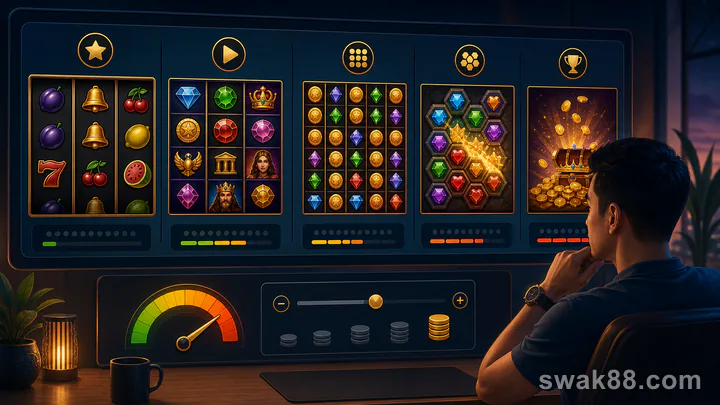
The Five Families of Online Slots
When people talk about online slots as if they were one thing, they miss the point: the reel layout and the way you win change completely from one type to the next. A classic three-reel machine and a Megaways title share almost nothing beyond the spin button. Knowing which family a game belongs to tells you, at a glance, how fast it plays, how often it pays, and whether it suits the way you like to bet.
This guide breaks the field into five families — classic, video, Megaways, cluster pays, and progressive jackpots — and explains how each one works and who it fits. You do not need to memorise every game; you need to recognise the type so you know what you are sitting down to.
The Five Types at a Glance
| Type | Reels / layout | How you win | Best for |
|---|---|---|---|
| Classic | 3 reels, 1–5 lines | Match symbols on a payline | Simple, low-pressure play |
| Video | 5 reels, 10–100+ lines | Paylines plus bonus features | Themes, free spins, variety |
| Megaways | 6 reels, variable symbols | Up to 117,649 ways per spin | Big-swing, high-action players |
| Cluster pays | Grid (e.g. 7x7) | Groups of touching symbols | Chain reactions, longer sessions |
| Progressive | Any layout, networked | Base game plus a shared jackpot | Chasing a life-changing prize |
Classic Slots: Three Reels, No Distractions
Classic slots are the oldest form and still the simplest. You get three reels, one or a handful of paylines, and traditional symbols — fruits, bars, bells, and sevens. You win by lining up matching symbols on a payline, and that is the whole game. There are rarely bonus rounds or free spins to track.
The appeal is clarity. With so few paylines, you always know why you won or lost, and the low complexity makes classic slots a calm place to start. They tend to suit players who find modern video games overloaded with features, or anyone who just wants to spin without learning a new bonus system every time.
Video Slots: The Modern Standard
Video slots are what most people now mean by online slots. They run on five reels — sometimes more — with anywhere from ten to several hundred paylines, and they layer on graphics, animation, themed content, and a bag of features: wilds that substitute for other symbols, scatters that trigger free spins, and various bonus rounds.
This is the most varied family by far, which is both the draw and the catch. Two video slots can play completely differently depending on their feature set, so the type name alone tells you less than it does for the others. When you open a video slot, the useful move is to read its feature list and paytable before betting — our guide to reading paytables, RTP, and volatility walks through exactly what to look for.
Megaways: Ways to Win That Change Every Spin
Megaways is not a single game but a reel engine, licensed by its creator Big Time Gaming and used under licence by many studios. Instead of fixed paylines, the number of symbols on each reel changes on every spin, so the number of ways to win shifts constantly — up to 117,649 at the top end. Wins come from matching symbols on adjacent reels from the left, however many ways happen to be live that spin.
The result is a high-action, unpredictable style. Because the ways to win swing so widely spin to spin, Megaways games tend to feel streaky, with long quiet stretches broken by sudden big-way spins. That rhythm suits players who enjoy the swings and have the bankroll to ride them; it is less comfortable if you want steady, predictable play.
Cluster Pays: Win by Groups, Not Lines
Cluster pays slots throw out paylines entirely. Instead of a grid of five reels, you get a larger symbol grid — often something like 7x7 — and you win when five or more matching symbols touch each other horizontally or vertically to form a cluster. Winning symbols then usually disappear and new ones drop in, which can chain several wins from a single spin.
That cascade mechanic is the signature of the family: one paid spin can keep resolving as long as new clusters keep forming. It makes for a different pace from line-based games — more about building chains than hitting a single line — and it appeals to players who like the drip-feed of repeated small wins within one spin.
Progressive Jackpots: A Shared, Growing Prize
A progressive jackpot is not a reel layout but an add-on that can sit on top of any of the other types. A tiny slice of every bet placed across a network of connected machines feeds a shared pot, which grows until someone hits it — sometimes reaching into the millions before it drops. Our breakdown of fixed, progressive, and must-drop jackpots covers how these prize types differ.
The trade-off is built into the design. That jackpot is funded by players, so progressives often return a little less in ordinary play than a comparable non-jackpot game, with the difference pooled into the prize you are chasing. They make sense when the dream of a single huge hit is the point of playing; they make less sense if you are trying to make a set bankroll last, since the everyday returns are usually thinner.
How to Pick the Right Type
Match the family to what you actually want from a session rather than picking on theme alone:
- Want it simple and easy to follow: classic slots.
- Want variety, features, and themes: video slots — but read the feature list first.
- Want big swings and don't mind long dry spells: Megaways.
- Want frequent chain reactions and a steadier drip: cluster pays.
- Want a shot at a life-changing prize and accept thinner everyday returns: progressive jackpots.
Before you spin any online slots for real pesos, do two quick things: identify which of these five families the game belongs to, then open its paytable to confirm how wins are formed and what the features do. The type tells you the shape of the game; the paytable confirms the details. Together they stop you from betting real money on a mechanic you have not actually understood yet.
Related Reading
For a closely related guide on this site, read Slots Casino Checklist for 2026: How Filipino Players Pick a Legit Site.