Choose the mechanic before the theme
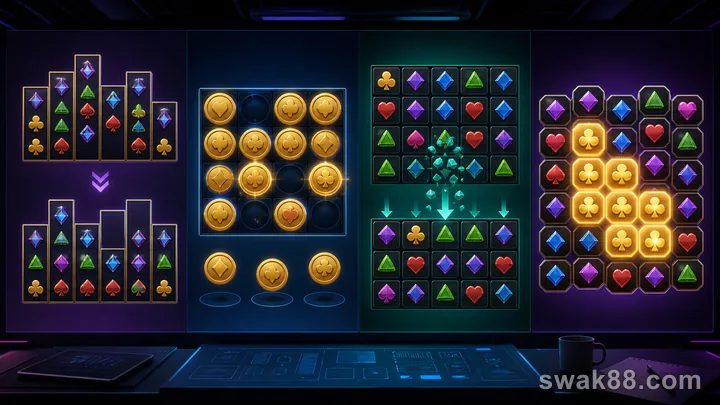
A slot online lobby can show hundreds of themes, but four mechanics explain much of how modern games feel: variable-reel Megaways-style systems, hold-and-win respins, cascading symbols, and cluster pays. None changes the fact that every paid spin is random. What changes is how wins form, how long one paid spin can continue, and where volatility is concentrated.
The practical choice is simple: variable reels suit players who enjoy changing layouts; hold-and-win suits players who want a clearly bounded coin feature; cascades suit players who like one stake producing several symbol drops; cluster pays suits players comfortable reading a grid instead of paylines.
Side-by-side comparison
| Mechanic | How a win forms | What can continue | Main learning task |
|---|---|---|---|
| Variable ways | Adjacent reels show changing symbol counts | Extra reels or modifiers may appear in a bonus | Read the current ways count and reel heights |
| Hold-and-win | Special coins lock while empty positions respin | Respins reset when a new coin lands | Separate coin values from jackpot labels |
| Cascades | Winning symbols disappear and new ones fall | More cascades occur while each drop wins | Track the total return for the original stake |
| Cluster pays | A group of matching adjacent symbols wins | Removed clusters can create new groups | Learn adjacency and minimum cluster size |
Variable reels and Megaways-style games
These games change how many symbols appear on each reel. The number of ways is normally calculated from the active symbol positions across consecutive reels, but the exact formula and whether symbols occupy more than one position depend on the title.
Do not assume every “ways” game is Megaways. Megaways is a branded mechanic with specific implementations, while other providers use their own variable-height systems. Open the help screen and check whether wins must start from the leftmost reel, how many consecutive reels are required, and whether an extra top reel contributes symbols.
In demo mode, play 30 spins at one stake and note the smallest and largest displayed ways count. The purpose is not to find a hot layout. It is to see whether you can read the changing reel geometry before the next spin. On a small Android screen, tall reels can make symbols and win markers difficult to follow.
Best fit: players who enjoy frequent visual variation and do not need a fixed payline map. Trade-off: the changing ways count can make identical-looking symbol groups pay differently from one spin to another.
Hold-and-win respins
A hold-and-win feature usually begins when enough special coin or value symbols land. Those symbols lock into a separate grid, and the remaining positions respin. Landing a new eligible symbol often resets the respin counter. The feature ends when the grid fills or the counter reaches zero.
Read four details before playing:
- The number of trigger symbols needed.
- Whether the feature uses the triggering stake to determine coin values.
- Which jackpots require filling the grid and which can appear on a symbol.
- Whether collected values are added once or multiplied.
A common mistake is to treat every visible jackpot label as equally reachable. Some require a full screen; others are random coin values; some scale with denomination. Record the exact trigger and ending condition.
Best fit: players who prefer a feature with a visible objective and limited respin sequence. Trade-off: much of the game's appeal can be concentrated in an infrequent trigger.
Cascading or tumbling reels
After a winning combination, its symbols disappear and new symbols fall into the empty spaces. If the new arrangement wins, another cascade occurs without a new paid spin. The sequence stops when a drop produces no win.
Check whether multipliers increase with each cascade and whether they reset after the sequence. In some games, only free spins carry a progressive cascade multiplier. In others, a base-game meter collects symbols across multiple spins. These are different value paths.
When a sequence ends, compare the total credited return with the original stake. Do not count each cascade as a separate paid round. A ₱10 spin with four cascades still began with one ₱10 deduction, though the game may display four win events.
Best fit: players who like extended outcomes and visible chain reactions. Trade-off: animations can make spending feel slower even when the next paid spin begins immediately afterward. Wait for the balance to settle before tapping again.
Cluster pays
Cluster games use a grid. A win normally needs a minimum number of matching symbols touching horizontally or vertically; diagonal contact may not count. The winning group disappears or transforms, then new symbols enter.
The help screen should specify minimum cluster size, adjacency rule, symbol values by cluster length, wild participation, and whether multiple clusters are counted separately. On irregular grids, edge shapes can change how groups connect.
Use screenshots from five demo spins and trace each winning cluster with your finger. If you cannot identify why a cluster paid, slow the animation or choose another game. This mechanic is easiest to misunderstand when bright effects cover the original grid.
Best fit: players who enjoy puzzle-like boards and do not care about traditional reels. Trade-off: payout reading is less intuitive for players trained on left-to-right paylines.
A 40-spin demo comparison
Play ten spins per mechanic with the same notional stake. Record load time, average seconds per paid spin, number of extended sequences, and whether the final credited amount was clear. Ten spins cannot estimate RTP or bonus frequency. It is only a usability sample.
For Philippine prepaid-data sessions, run the test on the phone and connection you actually use. Avoid repeatedly switching providers because each launch reloads assets. The budget Android slot test adds checks for heat, reconnect behavior, and interface scaling.
Final choice
Pick variable ways for changing reel structure, hold-and-win for a bounded collection feature, cascades for chained outcomes, and cluster pays for grid reading. Then verify the exact title's trigger, stake behavior, and settlement. A mechanic name describes the shape of play; it does not guarantee RTP, volatility, or value. Use demo mode to learn the shape, choose a fixed stake, and stop after the planned number of paid spins.
Common questions
Which mechanic is easiest for a beginner?
Hold-and-win is visually clear once triggered, but its base slot can still use unfamiliar ways. A fixed cascade game may be easier because one paid deduction begins the whole sequence. The real test is whether you can match every credit to the paytable.
Do more ways improve RTP?
Not automatically. More ways change how combinations form. RTP depends on the complete configuration, including symbol frequency, feature value, and stake rules. Compare the disclosed RTP version rather than the ways count.
Can demo mode reveal volatility?
A short demo can show pacing and interface behavior, not the long-run result distribution. Use it to learn controls and features. Do not promote a title because its first 40 virtual spins happened to win.
Related Reading
For a closely related guide on this site, read Types of Online Slots Explained: Classic, Video, Megaways, Cluster Pays, and Progressive Jackpots.